

Contents
Starting June 25, 2025, English is no longer a formality in trucking — it is the law. CDL inspections won’t stop at licenses and logs; officers will also test drivers on their ability to communicate in English.
Imagine being stopped by an officer. You’re standing there, heart pounding, knowing you’ll have to communicate clearly. But there’s no interpreter beside you, no friendly face to bridge the gap, no app you can quickly pull out of your pocket. It’s just you and the officer, waiting for your words.
Or imagine the weight of that moment: the pressure of knowing that if you fail, you’ll be placed out of service on the spot. No appeal. No help. Just the hard edge of the rule pressing down.
For years, English proficiency was officially required but loosely enforced. Violations rarely led to serious consequences. That era is over. Under a new FMCSA directive, English proficiency is now part of the North American Standard Out-of-Service Criteria. Language itself has become a gatekeeper to staying on the road.
A Rule That Changes the Game
The new enforcement introduces a two-step English test during inspections:
- English interview — inspectors will ask verbal questions, and drivers must answer in English without translation aids.
- Road sign comprehension — drivers must show they can understand and respond to highway signage.
Under current FMCSA enforcement, failure to communicate sufficiently in English, as determined by the inspecting officer, can result in immediate out of service orders. Under the President’s Executive Order 14286, “Enforcing Commonsense Rules of the Road for America’s Truck Drivers”, the language has been redefined to give inspectors broader discretionary power. What was once a guideline about communication standards is now a binding operational requirement. Failure to communicate “sufficiently”, as judged by the inspecting officer, can lead to immediate vehicle shutdown. This marks a significant regulatory shift — transforming subjective evaluation into an enforceable rule that directly impacts a driver’s ability to operate.
The Road Just Got Stricter for Non-Native English Speakers
For non-native speakers, this is more than a new box to check — it’s a fundamental shift in how their professional future is judged. For decades, immigrant drivers have carried the backbone of U.S. logistics. Many built careers through skill, reliability, and safety records, even if their English was not flawless. Suddenly, that experience counts for less.
The phrase “The road just got stricter” reflects a hard reality:
- A driver who safely manages a 40-ton truck, navigates multiple states, and delivers loads on time may now be sidelined for a language hesitation.
- Communication challenges including accents, nerves, or limited English skills can now lead to an out of service order in FMCSA CDL inspections.
- Inspectors have wide discretion. What qualifies as “sufficient English” can vary from one officer to another, adding a layer of subjectivity and uncertainty.
This is not simply compliance; it cuts into livelihood, safety, and dignity. Imagine being a professional with 15 years of spotless driving, yet facing unemployment because of how you answer a roadside question. For many non-native speakers, the rule feels less like safety enforcement and more like exclusion.
Driver communities are already sounding the alarm. In forums and industry groups, discussions about English proficiency have exploded. Anxiety is growing: drivers fear fines, forced downtime, or even losing their place in fleets. Fleet managers see looming operational risks and shortages if experienced drivers are pushed off the road.
The road has indeed become stricter — and non-native speakers are paying the price first.
Why Old Fixes Don’t Work
Standard solutions won’t solve this:
- Language courses are too slow and too expensive for an urgent challenge.
- Translation apps, cue cards, and interpreters are banned under the inspection rules.
- There is no shortcut — the industry needs a solution designed specifically for drivers.
Lingo Driver: The Practical Answer
Lingo Driver was built to meet this reality. It is not a generic translator; it is a professional companion for drivers facing English requirements in logistics.
The development team studied inspection reports and FMCSA guidelines to design lessons that reflect actual road situations rather than classroom theory. Every module has been refined through feedback loops and optimized to balance speed with retention.
This means that when drivers open the app, the content they see is practical, realistic, and aligned with how inspections and daily communication truly happen.
Lingo Driver is not just another language app — it is the result of dedicated effort to give drivers a fair, reliable tool for one of the toughest challenges in logistics careers today.
Key Features Include:
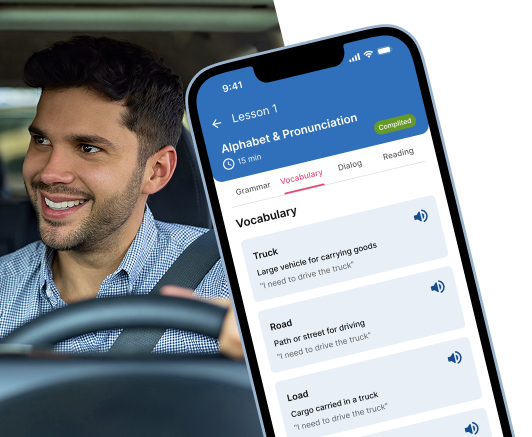
- English for CDL, rideshare & FMCSA safety — Learn tailored language for real driving tasks, from handling passengers to passing CDL exams, while mastering official FMCSA terminology and practicing realistic safety scenarios (e.g., inspections, police stops).
- Voice feedback & pronunciation tools — Practice speaking and get instant corrections to sound clear and confident.
- Job-specific vocabulary — Learn words drivers actually use on the road: dispatch, weigh stations, border checks, and more.
- Grammar practice & quizzes — Strengthen your English with lessons covering present, past, and future tenses, plus interactive quizzes.
- Flexible learning — Access lessons anytime, anywhere, with a multilingual interface.
Lingo Driver Positive Impact
Lingo Driver is a mobile-first solution designed for drivers’ daily routines. The app can be downloaded directly from the App Store (iOS) or Google Play (Android), making it simple to install on any smartphone. No special hardware or extra training is required — drivers can start using it immediately.
Because it runs on mobile phones, Lingo Driver is always available when it’s needed most — during breaks, at rest areas, or right before an inspection. The interface is straightforward, with clear navigation and large, readable fonts, making it easy to use even for those unfamiliar with technology.
- For drivers, it acts like a personal coach, preparing them with practical dialogues, compliance terms, and confidence-building exercises. Confidence on the road, fewer risks of being parked, peace of mind.
- For fleets, the mobile accessibility will allow managers to roll it out across entire teams quickly and cost-effectively. Reduced risks of downtime, fewer fines, and stronger driver retention.
- For the industry, it helps keep experienced non-native drivers on the road, turning a regulatory challenge into an opportunity for fairness and stability. Fairer standards and tools that bridge cultural diversity with regulatory compliance.
Lingo Driver was shaped by real driver concerns and industry discussions, addressing the very fears that are now a daily reality.
Lingo Driver doesn’t bend the rule — it prepares drivers to meet it.
“Language has become a new safety standard. Lingo Driver gives drivers the tools to protect their careers, no matter their accent or background”.
Industry Perspective: What Comes Next
The countdown to June 2025 has already started — a pivotal moment for the transportation industry. New regulations and evolving standards are reshaping how fleets and drivers operate. Those who begin preparing now will not only stay compliant — they will also remain competitive and better positioned for long-term success.
Lingo Driver is designed to help drivers adapt to these changes with ease. The app can be downloaded right now from the App Store or Google Play, offering an intuitive and accessible language support platform built specifically for professional drivers.
By breaking down language barriers, Lingo Driver ensures that skilled and experienced professionals are not pushed off the road simply because of communication challenges. Instead, it empowers them to understand instructions clearly, comply with new requirements, and operate confidently in a multilingual environment.
Preparation starts now, and fleets that act early gain the advantage. Lingo Driver equips drivers with practical English, CDL inspection readiness, and the communication skills needed to stay compliant and confident on today’s roads.
But the real challenge goes beyond compliance — it’s about connection. Every day, fleets lose valuable time and money due to misunderstandings between dispatchers and drivers who speak different languages. Missed instructions, delayed responses, and unclear communication can lead to frustration, lower performance, and even safety risks. Lingo Driver bridges this critical gap — ensuring that every message is understood, every instruction followed, and every driver empowered to perform at their best. In a world where precision and clarity matter more than ever, communication isn’t just a tool — it’s the road to success.


FAQ
What exactly changes in June 2025 for CDL drivers?
English proficiency becomes part of CDL inspections. Drivers who fail the test will be placed out of service immediately.
How will the English test work during inspections?
Two steps: an interview in English and demonstrating knowledge of U.S. road signs.
Who is most at risk under the new rule?
Non-native speakers — immigrant drivers, bilingual professionals, and fleets with multicultural teams.
Why can’t drivers just use translation apps or interpreters?
Because they are explicitly banned during inspections.
How does Lingo Driver help with this regulation?
It prepares drivers in advance through practical training, industry vocabulary, and voice-assisted practice scenarios. The app can be downloaded on mobile phones from the App Store or Google Play, so drivers can train anywhere.
How is Lingo Driver different from generic apps?
It is built for logistics, not casual translation, and focuses on compliance and road safety contexts.
Can fleets use Lingo Driver for entire teams?
Yes. Fleets can roll it out across driver groups to ensure consistent compliance and cut risks. Since it’s available on both iOS and Android, every driver can access it.
What benefits go beyond compliance?
Driver confidence, stronger reputation for fleets, reduced operational costs, and more inclusive standards for the industry.