


An oilfield service truck can leave a regional terminal and spend hours traveling to a remote worksite, while a petroleum tanker follows a carefully planned delivery schedule between loading and unloading facilities. Both operations require dependable location information, but neither can rely on a map alone to manage safety, equipment suitability, and compliance.
Fleet tracking solutions for oil and gas transportation help managers follow vehicles, coordinate arrivals, review trip history, and understand how equipment is used. The strongest implementations combine practical GPS visibility with established dispatch, driver-safety, maintenance, and emergency communication procedures.
The Special Demands of Oil and Gas Fleet Operations
Different Vehicles, Different Missions
Oil and gas fleets can include petroleum tankers, water-hauling trucks, maintenance vehicles, heavy equipment transporters, and field support trucks. A tanker loading appointment, a water-haul cycle, and an emergency technician dispatch are distinct workflows. Reporting should reflect the task rather than treating every vehicle as a standard freight truck.
Remote Geography Changes Reporting Expectations
GPS positioning uses satellite signals, while the device may depend on cellular service to send its location. A truck can continue recording positions while a dispatcher temporarily receives no updates. Companies operating beyond reliable cellular coverage should assess store-and-forward behavior and appropriate alternative communication procedures.
Tracking Does Not Replace Safety Compliance
Hazardous materials transportation may involve additional vehicle, driver, route, training, documentation, and emergency response requirements. GPS data can support operational awareness but is not proof that those obligations have been met. Applicable federal and state rules should be reviewed for each commodity and route.
| Vehicle category | Primary tracking priority | Operational decision |
| Petroleum tanker | Approved trips and terminal timing | Coordinate loads and exceptions |
| Water-hauling truck | Trip cycles and idle time | Review dispatch productivity |
| Field service truck | Current location and availability | Send a qualified crew |
| Equipment transporter | Movement and stop history | Coordinate heavy loads |
| Support vehicle | Remote movement and check-ins | Improve site coordination |
8 Ways Fleet Tracking Supports Oil and Gas Transportation
1. Locate Vehicles Traveling Between Remote Facilities
A centralized view helps dispatchers understand where equipment is operating between terminals, field sites, and customer facilities. When updates are delayed by weak connectivity, the interface should clearly distinguish a live position from the last reported one. Managers also need escalation procedures for communication gaps.
2. Review Routes and Unexpected Stops
Trip history can highlight detours, unplanned layovers, and routes that take longer than expected. Fleet managers can investigate these events against authorized routing, weather, traffic, and operating instructions. Routing decisions for regulated cargo must follow applicable restrictions and company safety plans.
3. Coordinate Tanker Dispatch and Loading Windows
Terminal schedules, vehicle compatibility, driver availability, and customer appointments must align. Position data helps dispatchers estimate arrivals and plan the next suitable assignment. GPS does not determine whether a tank, load, or driver is qualified for a particular hazardous commodity.
4. Separate Necessary Operations From Excess Idle Time
Oilfield trucks may remain stationary while powering equipment or operating a power take-off. Managers should distinguish this productive time from unnecessary tractor idling before reporting fuel waste. Compatible engine or PTO data may be needed for a reliable analysis.
5. Support Driver Safety Coaching
Speed history and compatible driving-event data may identify patterns for supervisor review. Training should emphasize approved routes, safe speeds, fatigue management, and incident reporting. Tracking is one input in safety management, not a substitute for driver training or supervision.
6. Improve Maintenance Planning for Demanding Duty Cycles
Heavy service schedules often depend on mileage, operating hours, inspections, and manufacturer guidance. GPS and telematics data can help maintenance staff identify vehicles approaching service intervals and plan work during available windows. A tracker does not diagnose every fault or replace required inspections.
7. Measure Terminal and Worksite Dwell Time
Geofences around loading racks, terminals, and customer locations can record arrival and departure events. Reviewing extended dwell time may reveal scheduling bottlenecks or repeated queues. Those records can inform dispatch planning and contract discussions when independently validated.
8. Create Better Operational and Cost Reports
Trip records, stop patterns, and vehicle allocation data support a more detailed view of transportation cost. Managers can compare runs with similar routes and loads, identify repeated empty returns, and review assignments by customer or field location. Reliable analysis requires correct vehicle, load, and job identifiers.
Selecting and Deploying Fleet Tracking in Energy Transportation
Evaluate Coverage Along Actual Routes
Test the corridors and sites vehicles really use, rather than relying solely on national coverage maps. Verify how long devices retain information while offline, whether alerts are delayed, and which communications channels are available during an emergency. Tracking and emergency communications should not be treated as interchangeable.
Create Appropriate Operational Alerts
Use carefully selected geofences for terminals, customer sites, and secure yards. Set movement alerts that reflect legitimate night operations rather than generating constant false alarms. Define who reviews an exception and who has authority to contact a driver or initiate a security response.
Illustrative Financial Comparison
Consider a hypothetical 20-vehicle operator with $700 in avoidable dispatch labor, $950 in unnecessary repositioning, and $350 in scheduling-related costs each month. That totals $2,000 in potential gross improvements. After a hypothetical $800 monthly tracking expense, modeled net benefits are $1,200 before implementation costs; actual results depend on measured fleet activity.
Where Ezlogz Can Help
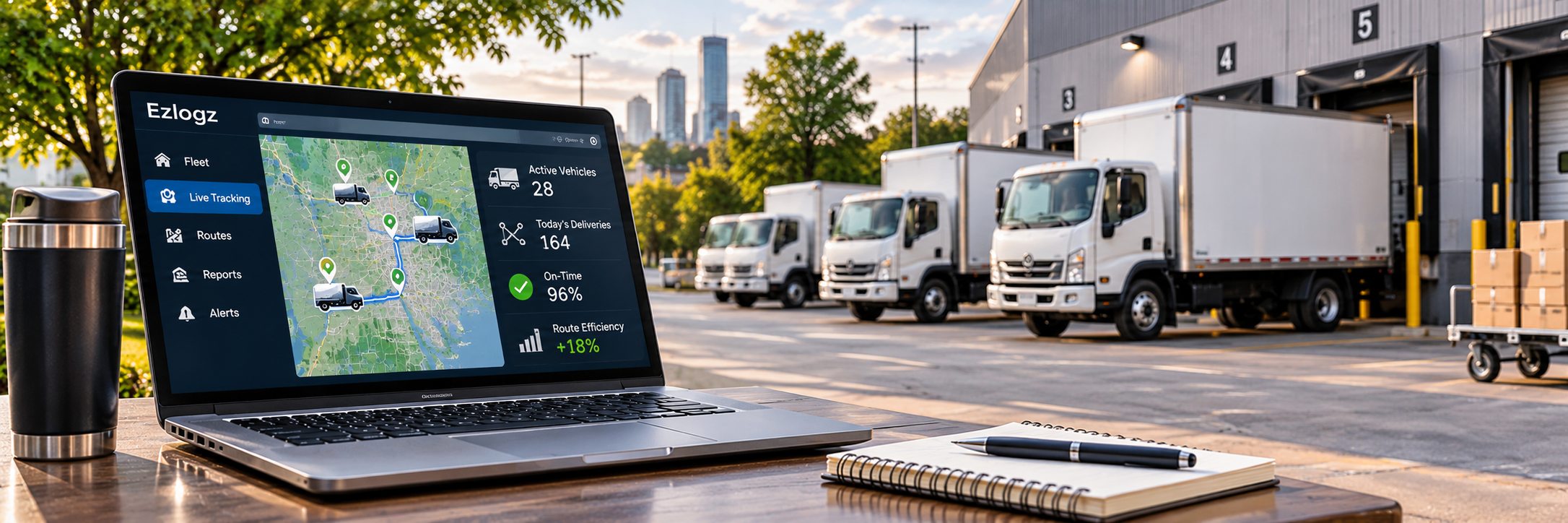
Ezlogz describes commercial fleet GPS visibility, geofencing, driving-related alerts, and reports. These tools may support transportation coordination in the energy sector. Customers must separately verify remote connectivity, hazardous-location hardware requirements, and any specialized tanker or oilfield integrations before deployment.
| Evaluation criterion | Questions for the provider |
| Remote coverage | What happens during cellular outages? |
| Alerts | Can unusual movement and terminal events be configured? |
| Trip records | Can timestamps and routes be exported? |
| Driver workflows | What ELD and dispatch integrations are supported? |
| Hardware suitability | Does it meet the installation environment? |
| Support | What is the escalation path for device failures? |
Operational Checklist for Remote Oilfield Fleet Tracking
Before Departure: Confirm the Complete Plan
Dispatchers should verify cargo compatibility, assignment, vehicle condition, route restrictions, driver status, and planned communication checkpoints. Location devices should be tested, especially where the trip enters areas of weak network coverage. The emergency contact plan should not depend on a single tracking device.
During the Trip: Prioritize Actionable Exceptions
Not every unexpected stop signals a serious problem, and not every missing update means a truck is stationary. Teams should look at the time of the last report, expected coverage, and scheduled operations before escalating. Any hazardous materials incident requires the response procedure applicable to that shipment, not a generic GPS alert workflow.
After Completion: Learn From Repeated Patterns
Compare terminal arrival times, route deviations, delays, equipment maintenance, and empty returns across similar trips. Discuss the causes with drivers and terminal staff. A recurring delay at the same site may be an appointment-process issue rather than a driver performance problem.
FAQ
It is vehicle and asset location monitoring used to support dispatch, route oversight, and operational reporting in energy transportation.
Yes, but the hardware installation and operating procedures must fit the vehicle and applicable safety rules.
Positioning may continue, but updates can be delayed until communication returns unless an appropriate alternative link is available.
No. Satellite positioning determines location; communication sends data to the fleet platform.
No. It can support oversight, but regulatory compliance requires additional processes, equipment, and records.
Dispatchers can use location visibility to estimate arrivals, review availability, and coordinate loading appointments.
It can reveal unnecessary movement and idle patterns, but work-related engine or PTO time must be accounted for.
Mileage, engine hours, service history, and inspection findings are important inputs where supported.
Consider loaded and empty miles, dwell time, idle hours, service compliance, and dispatch response times.
Verify installation suitability, remote coverage, offline buffering, reporting, security, and support.
Explore Ezlogz commercial GPS tracking solutions: https://ezlogz.com/gps-asset-tracking/




Comments