


Regional delivery fleets operate between two extremes. They serve more territory and longer recurring routes than most last-mile couriers, yet often complete more stops and tighter schedules than long-haul carriers. A regional operator may coordinate several distribution centers, mixed truck types, changing customer orders, and drivers who return to base at different times.
Managing regional delivery fleets more efficiently means reducing avoidable miles, assigning the right vehicle to the right depot, and using dependable operational data instead of assumptions. GPS tracking helps managers observe actual route performance and respond to exceptions, while connected dispatch, maintenance, and reporting workflows turn visibility into better decisions.
Why Regional Delivery Fleets Need a Distinct Management Approach
Recurring Routes Create Both Opportunity and Waste
Regional carriers often travel the same corridors several times a week. Familiar routes are easier to benchmark, but inefficient habits can become embedded: unnecessary depot returns, poor stop order, and vehicles routinely sent from the wrong location. Reviewing route history can show where recurring schedules need adjustment.
Multiple Depots Complicate Driver and Vehicle Assignments
A vehicle may finish near a different distribution center from the one where it started. Without a current view of truck positions and assignments, dispatchers can miss opportunities to combine deliveries or reduce empty repositioning. The best assignment also depends on payload capacity, driver availability, and customer commitments.
Regional Delivery Differs From Last-Mile and Long-Haul Work
Last-mile couriers optimize dense sequences of local stops; long-haul operators focus on extended interstate trips. Regional fleets must balance multi-city routes, moderate stop frequency, depot replenishment, and return-trip opportunities. They need KPIs that cover both distance efficiency and completed deliveries.
| Operation | Main challenge | Useful KPI |
| Last-mile | High stop density | Cost per stop |
| Regional delivery | Multi-city schedules and depots | Cost per delivery and empty miles |
| Long-haul | Extended transit and driver hours | Cost per loaded mile |
| Regional multi-depot | Vehicle allocation | Utilization by depot |
8 Strategies for More Efficient Regional Delivery Operations
1. Centralize Regional Vehicle Visibility
Dispatchers managing multiple service territories benefit from a single map of available and assigned trucks. GPS records reduce repetitive status calls and help supervisors respond to late arrivals. Vehicle positions should be combined with load status so that proximity is not mistaken for availability.
2. Optimize Recurring Routes With Historical Data
Compare actual mileage, travel time, and stop duration on routes repeated each week. A schedule may look efficient on paper but encounter the same congestion or receiving delays every Tuesday. Revising departure times, stop groupings, and assignments based on actual patterns can improve consistency.
3. Coordinate Loads Across Multiple Depots
When several depots serve overlapping areas, dispatchers should consider where the load is located, which truck is suitable, and what the driver can complete during the shift. A centrally visible fleet makes it easier to spot mismatches and avoid unnecessary transfers between depots.
4. Reduce Empty and Repositioning Miles
A regional truck may return with little cargo after delivering to a neighboring city. Managers can review whether pickups, reverse logistics, or future delivery routes could reduce those empty legs. Tracking identifies travel patterns; load matching and customer scheduling provide the actual operational change.
5. Balance Driver Workloads
Uneven assignments can create overtime for one driver while another finishes early. Compare planned and actual route duration, delivery workload, and applicable duty-hour limits. Fair scheduling should reflect traffic conditions, customer delays, and vehicle capacity—not just the number of stops.
6. Plan Maintenance Around Delivery Cycles
Regional vehicles may accumulate considerable mileage while making frequent stops that affect brakes and tires. Scheduled service should reflect mileage, inspection results, and manufacturer guidance. Managers can reduce disruption by planning maintenance on routes or days with lower demand.
7. Improve ETA Communication
Accurate arrival windows depend on current locations, expected stops, unloading time, and traffic. Dispatchers can use tracking and order information to flag routes likely to miss appointments and contact customers earlier. Visibility is most valuable when it leads to timely communication.
8. Measure Route Profitability and Vehicle Utilization
A fleet-wide average hides routes that perform very differently. Analyze delivery revenue, operating expenses, loaded and empty miles, depot time, and successful stops by route. This helps leaders decide whether to redesign a route, change vehicle size, or review a delivery schedule with a customer.
Implementing a Regional Fleet Management Improvement Plan
Start With Route and Depot Benchmarks
Capture four to eight representative weeks of mileage, stops, delivery performance, driver hours, and vehicle assignments. Separate daily recurring routes from one-time exceptions. Create comparable regional categories before deciding that one depot or driver is inefficient.
Select Useful GPS and Dispatch Capabilities
Look for live vehicle visibility, trip history, geofences, mileage reports, driver access, and compatibility with existing dispatch processes. A GPS platform does not automatically optimize complex multi-depot schedules; confirm what routing and order integration is available.
Example: Three Depots and 30 Trucks
Suppose a 30-truck operator identifies $1,400 in avoidable repositioning fuel and vehicle costs, $900 in dispatcher labor, and $700 in recurring overtime each month. Hypothetical gross savings are $3,000. With a $1,000 monthly technology cost, modeled net savings are $2,000 before setup expenses. Verified results require actual baseline and follow-up data.
Connect Regional Visibility With Ezlogz
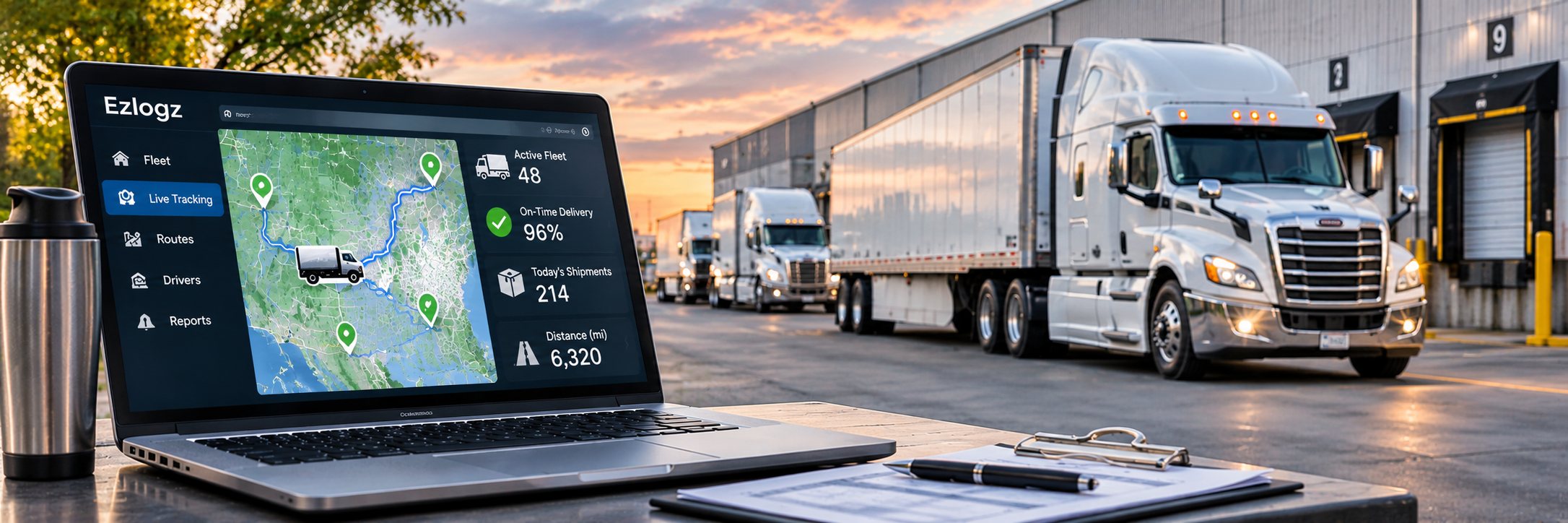
Ezlogz provides published information about commercial GPS tracking, geofencing, location history, and reporting. Regional operators can use those capabilities as a visibility layer and evaluate which dispatch or route tools integrate with their particular delivery workflow.
| Regional KPI | Why it matters |
| Empty-mile percentage | Measures non-revenue travel |
| Cost per completed delivery | Connects cost with output |
| On-time delivery rate | Indicates service consistency |
| Deliveries per driver shift | Shows assignment productivity |
| Dwell time by depot | Highlights loading delays |
| Vehicle utilization | Identifies underused capacity |
A Weekly Operating Rhythm for Regional Delivery Managers
Monday: Review Demand and Available Vehicles
Compare planned loads, driver schedules, maintenance restrictions, and depot capacities. Identify delivery zones where orders can be consolidated rather than sending multiple partially loaded vehicles. Confirm that every assigned vehicle is suitable for its route and cargo.
Midweek: Respond to Route Exceptions
Review recurring late arrivals, extended depot loading, driver overtime, and unnecessary returns. Use GPS history and dispatcher notes to separate traffic-related delays from avoidable route design. Make small operational changes and record them so the next comparison is meaningful.
Friday: Review Costs and Service Performance
Compare cost per completed delivery, empty-mile share, on-time arrivals, and depot dwell. Highlight only changes that affect decisions: shift a stop to a different route, revise a loading window, or reassign a spare vehicle. Weekly reviews create a feedback loop without requiring a complicated reporting program.
FAQ
It is the coordination of vehicles, drivers, depots, and recurring routes serving customers across a defined multi-city region.
Regional routes cover larger territories with a different balance of stops and distance; last-mile operations emphasize dense local delivery.
It gives dispatchers vehicle visibility, trip history, arrival events, and a better basis for investigating delays.
They can improve pickup planning, consolidate orders, and select better assignments using route and load data.
It helps show where vehicles are; effective depot coordination also needs order, vehicle capacity, and driver availability information.
Cost per delivery, empty-mile share, on-time rate, fleet utilization, and average depot dwell time are useful starting points.
Yes, provided the tool accounts for delivery windows, capacity, road suitability, and recurring demand.
They can monitor route progress, identify exceptions early, and notify customers when arrival plans change.
Review exceptions daily and compare larger performance trends monthly or after meaningful demand changes.
Start with basic location visibility, accurate dispatch records, a small KPI set, and measurable improvement goals.
Explore Ezlogz commercial GPS tracking solutions: https://ezlogz.com/gps-asset-tracking/





Comments